Labels

Thursday, 7 June 2012

week 13 drama

Drama Workshop 3-
7th of June 2012

Dear Diary,   

                       “Teacher in Role”


Today in my final workshop we looked at the teacher in role process. Victoria assigned the class in groups of four, where we had to come up with a script and only one of our group members had to talk for the otheras though they were the teacher in role. From this pathway we had to come up with an introductory speech where we had to think of the context and how we could link our main idea to other KLA'S. As a group we decided to link Ancient History. As a group we had decided to go way way way back in time and pretend to have someone act as a mummy. The scene was set to be in the desert. As a group we came up with the script, where we focused on the key aspect TENSION. We also decided to use two props which were a mobile phone and coffin. My friends role was to stand in front of the class and read out the script and act it out. After she had performed the script, the class had to predict who who she was that she was acting out there characteristics. The class also had to guess the scene location.


Thursday, 31 May 2012

week 12 drama

Drama Workshp 2-
31st of May 2012
Dear Diary,

                                  PRE TEXT

 
In today's workshop, my focus was on the Read pretext where we had to read the fragment given to us along with two supplementary questions including: What do you know from reading it? What questions are beginning to form? Firstly, I had no idea what a pretext was until today's workshop, from students answers as well as Victoria's comments I was familiar and able to grasp on the meaning of a pretext. This enabled me to grasp the key idea for today's workshop. Our group came up with five insightful questions including, where are you from? Why are you here? What do you eat? Do you have supernatural powers? Who are your parents? Who found them? For future implications, I would allocate a similar script to students where I would imply questions in telling students that we are looking for an inference and that are free to create a sense of things that may occur in the pretext or that have come to their mind whilst reading the pretext. In reflection to the k-6 creative arts syllabus, drama-making outcome DRAS1.2 conveys, story, depicts events, and expresses feelings by using the elements of drama and the expressive skills of movement and voice. As becoming a teacher, I would make easy for students to make decisions about role and action for when they explore the various drama techniques in thinking about ideas and questions extracted from the pretext such as who, what, where, when and why.

Thursday, 24 May 2012

weel 11 drama

Drama workshop - 1

24th of May 2012

Dear Diary,

In today's workshop, my focus was on the picture book "Voices in the park" by Anthony Browne. We listened to Victoria read the book with such a dramatic tone of voice. This technique and the main themes of the story allowed grasping the key idea of the Authors meaning to his audience. The book entails such great pictures along with great grammatical features. I was able to activate my prior knowledge to Edup 2002 when we read this book in the lecture and the book I had to do for my assignment so it really helped me to gain further insightful knowledge about the purpose/content and main ideas of the book. For teaching practices, I would take aboard a similar lesson as the one today. I would read a different picture book to the students. The picture book may be, "Lost and Found" by Oliver Jeffers. The story will be read to the students and students are then allowed to construct a Role on the wall/word bank where students have give the two main characters a name example loved, angry so forth. In reflection to the K-6 creative arts syllabus, students are performing DRAS1.3 Interacts collaboratively to communicate the action of the drama with others.


Thursday, 17 May 2012

week 10 visual arts

Visual Arts workshop 3-

17th of May 2012

Dear Diary,


                                      "Painting"


My focus from today's workshop was the elements and principles of visual arts through my painting. There were various principles discussed including 9 and beyond along with 6 elements that correspond with the 9 principles. There were new words I would take aboard throughout my teaching career, these new words included: unity, perspective, and discord. Before I came into this workshop, I was very unfamiliar with these words until today I understood what each of these words meant. For future implications towards becoming a professional educator, I would allocate students an example of an artwork and then I would allocate them time for them to come up with a few questions about the artwork. Questions can be: Tell me about the patterns in the picture. Where is it located? Why is this colour purple? In reflecting on the K-6 creative arts syllabus, appreciating outcome VAES1.3 Recognises some of the qualities of different artworks and begins to realise that artists make artworks. Students are able to make connections with the artwork displayed and are also able to express ideas to other peers in the classroom.
For me, painting is a way to forget life.  It is a cry in the night, a strangled laugh.  ~Georges Rouault
The world today doesn't make sense, so why should I paint pictures that do?  ~Pablo Picasso


Thursday, 10 May 2012

week 9 visual arts

Visual Arts workshop 2 -

10th of May 2012

Dear Diary,


“Direct Observation Collage"


In today’s second workshop I took part in making a collage using my previous sketched drawing (Bulky Newsprint of my Bicycle). I began the collage by choosing a small square section of my drawing and then enlarged the chosen section onto art paper. Once I had enlarged my section, I was given the opportunity to limited materials that included newspaper, black paper, foil and paper. I found this activity being practical and required specific attention and technique. This allowed me to understand that you experiment further from something that looks finished and cannot be altered or enhanced. This allowed me to be creative and incorporate spontaneous ideas throughout producing my artwork. Thus, as a pre-service teacher I would implement these activities where students are able develop beyond their capabilities which then allows students to appreciate their work and understand the uniqueness of art.


Thursday, 3 May 2012

week 8 Visual Arts

Visual Arts workshop 1 -

3rd of May 2012

Dear Diary,

      "Direct Observation"


This is my own sketched image of a Bicycle that I had drawn originally Photographed by Sheldon Brody in 1967. Through observing the Photograph displayed on the board. I analysed the image focusing on the key elements of VIsual arts. Through observing the image I was able to look at the different tones, colours, patterns, lining, shapes, volume, etc used in the Photograph.
 

This activity is seen as enjoyable and engaging to incorporate in the classroom as this activity will further allow students to explore the various use of elements and principles that is involved in art making process. students take on a role by critically reflecting on their artwork it self by asessing from the folowing three questions such as; What is it?, Who made it?, What is it about?, etc. students are given the opportunity to explore the importance of these elements and techniques, it will allow students to strongly create a sense of meaning and understanding towards the art work.

Art is Man's nature.  Nature is god's art.  ~James Bailey

Thursday, 26 April 2012

week 7 music

Workshop 3

26th of April 2012

Dear Diary,

               The Jelly Beans Book"

The last workshop for Music was by most the interesting and fun way to end the workshop!! Today's workshop, covered reading the book "Jellybeans book" which I found it an interesting and engaging book. During the lesson we read parts of the book, where we went through the song and in each section we had to play some sort of musical instruments.  Thus, this helped us become familiar with the different musical notes. This can be effective within a primary classroom, were you can teach students the different music notes through instruments and while they are playing and making their own music. As a pre-service teacher I had found the Jelly Bean Book in being effective as a teacher’s resource in teaching students the musical notes and to assist them in playing the musical instrument effectively and spontaneously!!


Thursday, 19 April 2012

week 6 music

Workshop 2 -


19th of April 2012


Dear Diary

"The Joy of Singing"

Moving on from the previous workshop, I have grasped the main elements of music along with being introduced to a range of musical pieces. In reflecting back to today's workshop, I felt confident towards my future implications to becoming a primary school teacher towards "teaching Singing.” I was able to reflect on the tone of voice including the five different tones to the different types of music. This helped me to improve my own vocal technique as well the future students at schools. For future implications, it will allow students to focus and improve on their skills prior to singing for an extended time. Future references towards becoming a teacher I would utilise various breathing and vocal exercises for students to develop awareness about learning how to sing. Possible assistance is needed to teaching students the tricky bits but overall the breathing exercises could be placed around the classroom for children to view and participate in the regular classroom musical activities.

Thursday, 5 April 2012

week 5 Music

Music Workshop 1 -


5th of April 2012


Dear Diary,

"Elements of Music"

Today was the first music workshop from the four creative art strands. I was introduced to the five concepts of music revolving on duration, pitch, tone, colour, dynamics, and structure. My focus for today's workshop was in the "Scoo Be Doo Song" from rainbows, trees and tambourines caregiver, and Teacher's book. This piece of music is my target reflection as it such an essential piece of music to utilise with young primary students. From viewing and singing this piece of music, I was able to decode the piece by focusing on how the piece is out together through the verse and chorus. Also how the instrument is played, what type of musical instruments is needed, and how it is made. As a result from today's focus lesson, for future reference and implications for me in becoming a primary school teacher. I would utilise similar musical pieces like the one discussed above and introduce a range of songs to the children to build their awareness on the Five conepts of music. I could teach the song phrase by phrase and then arrange students into smaller groups to sing certain parts - solos 1,2,3,4 verses. Flashcards, relevant written information on the board will assist students in developing skills and build on further knowledge. In  becoming a teacher possible questions can be asked to students to stimulate their knowledge and skills such as: How would you describe this piece?, describe the rhythm. I could introduce a range of musical intruments for children to experiment through sound and sensory movement.

http://www.youtube.com/watch?v=Mvh4zEKG2zs

Thursday, 29 March 2012

week 4 dance

Workshop 3 - 29/3/12

Dear Diary,

Through today’s workshop I was introduced to

five types of stimuli: 1. Visual stimuli, 2. Auditory stimuli, 3. Kinaesthetic, 4. Tactile, and 5. Ideation. My group today focused on the Lion king musical piece. We emphasised the notion of terror, warrior, missionary, and battlefield. For our dance performance, each group held arrow spears and were fighting the opposing tormentors in order to save the emperor. I demonstrated structured knowledge to how a dance lesson should be constructed and also the appreciation aspect of the dance lesson in terms of the positive feedback was improved where I now I'm able to develop further knowledge and technique to how a dance lesson should run. In becoming a professional teacher, critical thinking was required from my knowledge in how to incorporate a positive dance lesson where this could done by taking: correct decisions, making sure the dance lesson fall into three components, composition, performance and appreciation and also allowing children to express their ideas and emotions within the space and learning environment they are in.


Thursday, 22 March 2012

Week 3 Dance

Workshop- 2

22/3/12

Dear Diary,


Today in my group, I explored the topic "musical stimuli" where we constructed a dance performance based on the notion of social inclusion and emphasising the awareness of stereotypes that we may come across during our lives. My musical peice was  called "Oh my god" based on the movie "legally blonde" as this emphasised the notion of stereotypes. The main idea was that "people shouldn’t judge a book by its cover.” Throughout the decision making process for the dance performance, I was able to link back to my prior knowledge in terms of which dance element did we have to focus on in order to achieve the idea of our topic for the dance performance. In being a pre-service teacher so far, it has come to my understanding on how to incorporate a positive dance lesson. This could be done by taking: correct decisions, making sure the dance lesson fall into three components, composition, performance and appreciation and allowing children to express their ideas and emotions within the space and learning environment.


Thursday, 15 March 2012

Week 2 Dance


Dance Workshop 1 - 15/3/12


Dear Diary,


In Today’s workshop, I participated and developed further knowledge to differentiate between the physical and social learning in dance. I was introduced to five new dance actions: Leap, jump, twist, hop, and clap. By having this stimulus around the classroom, it helped me to focus, attend to any type of activities that had to be developed and shared in the classroom. In regards to future implications, I would use those five dance actions flash cards and assemble them appropriately according to the structure and layout of the classroom and depending on where the students are positioned around the classroom. In applying this strategy into the classroom, it allows students to work independently, share skills and knowledge amongst their peers, become motivated and participate in all classroom activities and students are able to use those five dance actions as a guide to how they might want to demonstrate and present their constructed dance performance.


"Dance is poetry written for the feet, read by the heart, and destined for the soul." Adrienne Hughes 2005

Saturday, 10 March 2012

What Good are the Arts? (Lecture 1)

What Good are the arts???                           9/03/12


Today I began the first and only lecture to the second year primary education unit: Edup2007 Creative Arts with a very warm welcome. I was exposed to a book called: "What good are the arts" by John Carey. I viewed the front cover of the book and I automatically created this image in my mind about what is art and how it makes me feel confident, creative and wanting to become an artist in the future. Part of the set task was to choose from creating a poem/performing what good are the arts/ hot seating/ tap in. So I decided to pair up with a peer member and we both decided to create an acronym from the word: "ART".We came up with A= artistic, R=realistic and T=time. From writing an acronym I was able to decode such processed information to what art is about, what it involves and what inspiring things you can come across throughout your art journey/experience. I was exposed to a range of other different activities such as rhyming poem, hot seating, song and tap in, where these activities made my knowledge more broad while accompanying different ideas and concepts about art. For future implications as a teacher, I would use these types of strategies with the children in the classroom where for example I would show them a artwork from a famous artist and I'd ask open-ended questions to what the picture might be representing, given any other details. Building on from prior knowledge this allows children to further develop creative skills into thinking deeply to what covers art and its aspects. As a pre-service teacher, today's lecture gained me knowledge that I could further plan and implement beyond my teaching expectations.


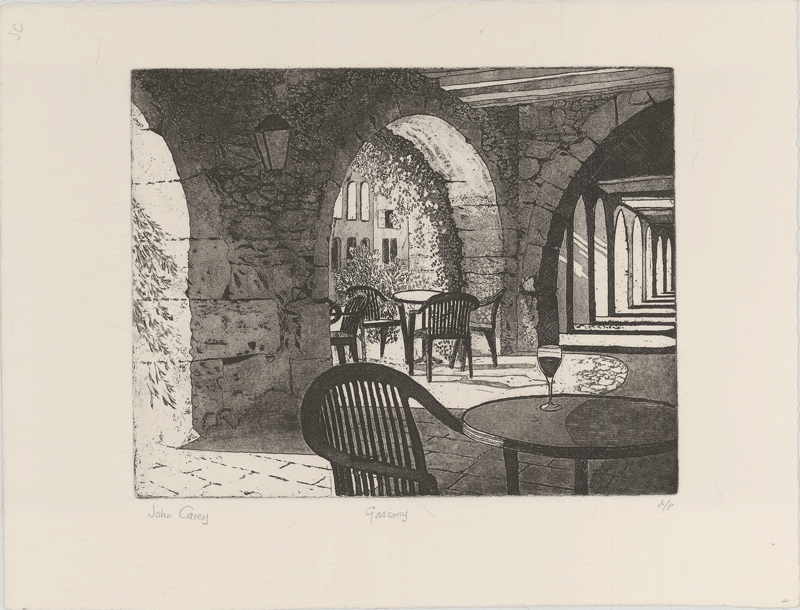
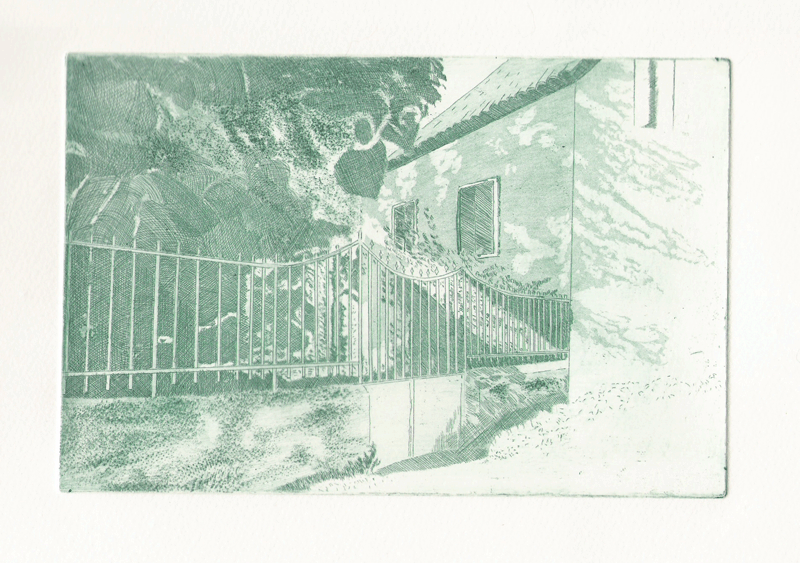
Le Romieu. Etching and AquatintCevennes. Etching and Aquatint


Friday, 9 March 2012

week 1 intro lecture

Welcome!!! Edup2007 2012


       WELCOME!!!WELCOME!!!


               Hi My name is Souha Malak

                    This is me in the photo:)


Welcome to Souha's Edup2007 reflective scrapbook journey of numerous entries. I am studying a bachelor of Primary Education at the University of Sydney. This is my second year at Sydney University where I undertaking Edup2007 Creative Arts. During First year, second semester at University I undertook Creative Arts 1 where I experienced all the four creative art forms that is: Drama, Music, Visual arts and dance. I really enjoyed it , it was such a great experience and I was able to link information to my prior knowledge and be able to plan and implement further for the future. Now for this Edup2007 I'm expecting the outcomes as last year, and of course building further knowledge and experience for becoming a Professional teacher in the future. Throughout the upcoming blogs, my blogs will be about reflecting on the four Creative Art forms that is Dance, Music, Visual Arts and Drama. The following blogs will be about reflecting on the practical exploration of the four Creative Art forms i.e Dance, Music, Visual Arts and Drama through using different elements of texts, techniques, composition of sequence to experience the positive aspects of the Creative Art forms. Not only is it just important to include the name/title and background for a blog, but it is most important that the blogs reflect on the four Creative Art forms which than leads me into writing positive reflections for future implications towards teaching in a positive learning classroom environment.